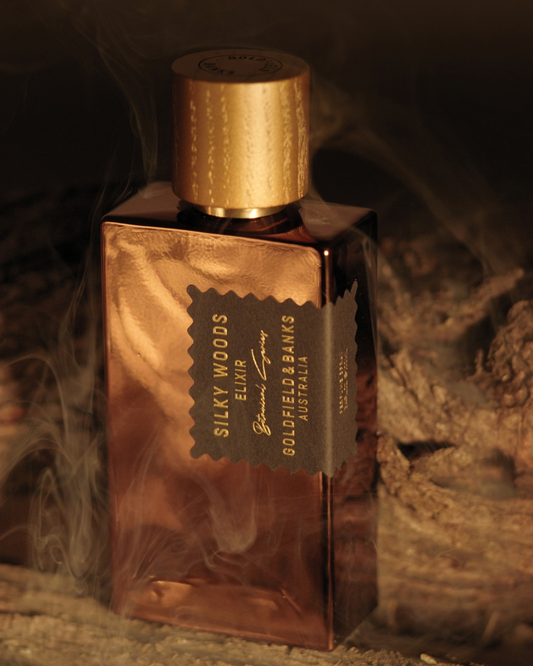
Clearwood is a patchouli-like woody ingredient from dsm-firmenich, produced by white biotechnology rather than by distilling patchouli leaves. It belongs to the woody family and smells like a cleaner, softer patchouli: dark and woody with a creamy, ambery warmth, but without the earthy, musty and camphorous edges of the natural oil.
What does Clearwood smell like?
Clearwood keeps the rich, woody core of patchouli while stripping back its heavier facets. There is a smooth, slightly sweet woodiness, a velvety amber-like warmth and a quiet depth that reads as modern and polished. Compared with Indonesian patchouli oil it is less earthy, less medicinal and less dusty; compared with patchouli fractions such as heart cuts it is rounder and more transparent. It is rich in patchoulol, the key molecule of patchouli oil, which is why it blends so naturally with the real thing.
Where Clearwood comes from
Instead of harvesting and distilling Pogostemon cablin leaves, Firmenich developed a biotechnological route in which microorganisms produce the patchouli-type material under controlled conditions. This decouples supply from harvests, weather and price swings in the patchouli-growing regions of Indonesia.
- Also known as: Clearwood (trade name)
- Fragrance family: Woody
- Type: Synthetic (biotechnology-derived)
- Made by: dsm-firmenich (formerly Firmenich)
- How it's obtained: Fermentation-based white biotechnology
- Key aroma molecules: Patchoulol
Clearwood in perfume history
ScenTree dates the material's discovery to 2003, and the Clearwood trade mark was registered in 2014. It is one of the better-known perfumery ingredients made through white biotechnology, a field that has since grown to include other woody and ambery materials.
Clearwood in modern perfumery
Perfumers use Clearwood in two ways: at modest doses as a creative, patchouli-like accent, and at higher levels as a foundational woody building block. It is certified readily biodegradable and is unrestricted under the 51st Amendment of the IFRA Standards, which makes it attractive for both fine fragrance and consumer products. Its steady, harvest-independent supply is a key selling point as brands look for more sustainable woody materials.
How Clearwood wears and what it pairs with
Clearwood behaves as a heart-to-base note with good tenacity, giving body and smoothness to a composition. It pairs well with patchouli oil, vanilla, rose, amber, cedar, vetiver, bergamot and chocolate or cacao notes.